Duplicate contacts and listings: how the CRM catches them before they cause a problem
RealEstateCRM España · 28 September 2026
An agent at an agency in Murcia registers a hundred-and-ten-square-metre flat in the Vistabella neighbourhood on a Tuesday morning, straight after the viewing with the owner. On Thursday, another agent at the same office takes a call from that same owner, who wants to list "the flat I showed you last week", and registers it too, with no idea a listing already exists, opened two days earlier with the same address. Now there are two listings for the same flat, each with its own price and its own photos, and two agents each convinced the sale is theirs.
A real estate CRM catches a duplicate listing or contact by checking every new record against the ones already in the system — by address or cadastral reference for a property, by channel and contact details for a person — and flags it before a second record gets created. In RealEstateCRM that check happens right at the point of registering, not in some quarterly clean-up nobody ever finds time for.
Two agents, one listing, two records
The Vistabella case isn't unusual in an office with several agents working the same patch: same neighbourhood, similar type of property, and neither one aware the other has already spoken to the owner. It also happens the other way round, with a property first entered as a direct instruction and entered again weeks later because someone spots it live on a portal and registers it thinking it's a fresh find. Left unchecked, the portfolio ends up with duplicate records that throw off any report on active listings, and if each one carries a different price, they confuse a buyer who sees both back to back on the same portal.
How the Properties module stops the duplicate
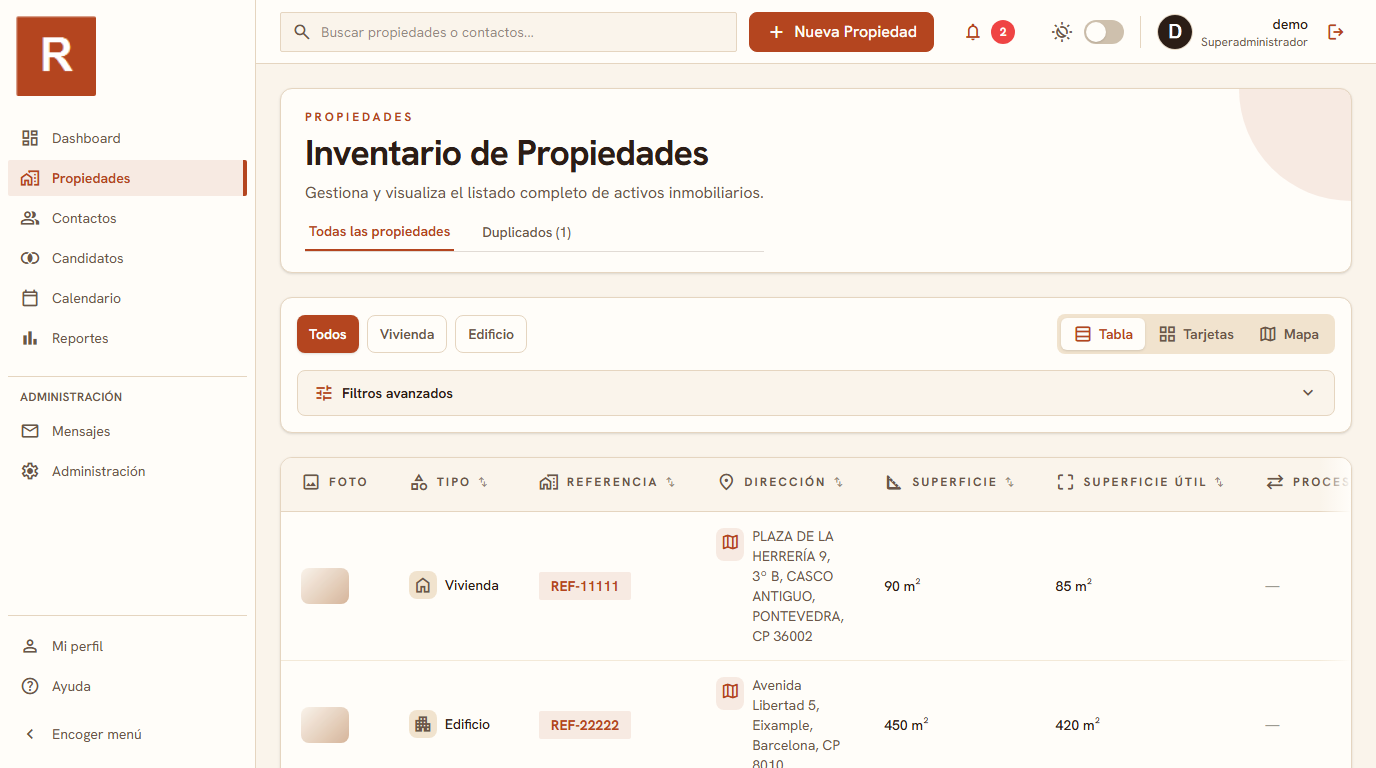
When you register a property in RealEstateCRM, searching by address or cadastral reference doesn't just fill in the floor area, the year built and the rest of the fields the Land Registry already holds on its own: it also checks whether that same address or reference is already in the portfolio, and if it is, flags it before the agent finishes creating the record. There's no need to remember to search the property list by hand, or ask around the office group chat whether someone's already registered it: the warning shows up in the same step where the flat is being created, with the original record one click away.
Duplicate contacts: when the same buyer writes in twice
With contacts, the problem takes a different shape. The same buyer might message on Instagram on a Monday asking about one flat, then message again on Friday through a portal's contact form asking about a completely different one. If every channel opened its own record, one agent would end up hearing half the client's story and another agent the other half, with neither realising there's more of the conversation than what's in front of them.
RealEstateCRM connects Instagram, Facebook, TikTok Forms, WhatsApp Business and the portals' email from the integrations panel, using your own accounts, and every lead that comes in through any of those channels gets cleaned of duplicates automatically before it turns into a contact, with the channel it came from saved on the record. When someone needs to check by hand whether a buyer who's just called already has a record open — say, for a viewing that shows up without an appointment — the global search crosses properties and contacts in a single box and settles it in a couple of seconds, without having to scroll the full contact list first.
A case: the same development, twice
An agency with two agents prospecting the same stretch of the Costa Blanca ended up, without noticing, registering the same house twice in the same week: one agent took it on after a direct viewing with the owner, and the other spotted it advertised by that same owner in a neighbourhood Facebook group and uploaded it too, convinced it was a fresh find. The second time the record was created, the CRM flagged that a property already existed at that address, and the second agent was able to open the original listing and let their colleague know on the spot, instead of the two records sitting side by side for weeks with different prices until someone noticed by chance while comparing portfolios.
That same week, a buyer who'd written in over WhatsApp asking about a townhouse wrote in again through a portal's email asking about a different flat; the CRM recognised it as the same contact and added the second interest to the record already open, instead of creating a new one holding only half the history.
This detection sits alongside the rest of the Properties module's features, and the automatic Land Registry lookup that fills in the details on every new listing. If your team also wants to check by hand whether a contact already exists before creating a new one, the article on the global search that crosses properties and contacts is a good next read.