A complete property record: features by property type and the sale or rental process
RealEstateCRM España · 16 November 2026
It is six in the evening and a buyer rings about the ground-floor shop on the avenue you advertised last week. They want the square metres, whether it has a street-facing window and whether the owner would rent it or only sell. The agent who listed it is out on a viewing across town. Whoever picks up the phone opens the record and, if it is done properly, answers all three questions before hanging up. If not, it is the usual "we will call you back tomorrow".
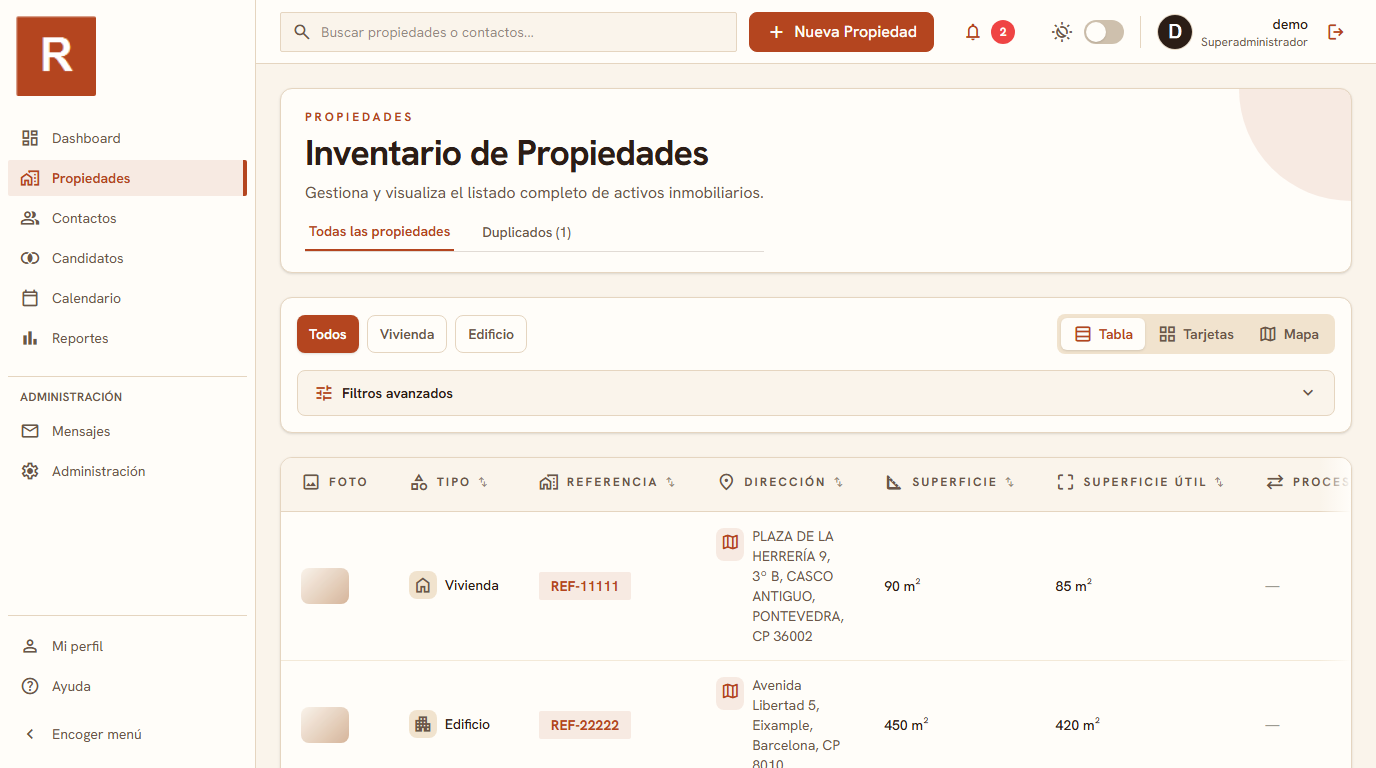
A property record in a real estate CRM is the single entry for each property in your portfolio: its physical data, the features that change with the property type, the photos in the order you want to show them and where the sale or rental process stands. If anyone in the office can answer a client using only what is in it, the record is complete.
A flat is not described like a shop
The most common mistake with spreadsheets is having the same columns for everything. You end up with an empty "bedrooms" cell for every shop, a "shop window" column nobody understands for flats, and a notes column where everything important ends up. When you need to find something, it has been written four different ways.
In RealEstateCRM the record's features are specific to each property type, so the form asks what makes sense for what you are adding and does not make you fill in what does not apply. It sounds like a design detail. In practice it is what makes the data comparable: if every home stores bedrooms in the same field, the matching can use them, and so can the portfolio report.
What the Land Registry fills in and what you add
The record does not start blank. When you create it you search by address or cadastral reference, and the floor area, year of construction and reference fill themselves in from the Spanish Catastro. At the same time the CRM checks whether that address or reference is already in your portfolio, so you do not end up with two records for the same flat. We go into more detail in which fields the Catastro lookup fills in.
What the Catastro does not know, you do: the state of the kitchen, whether it faces the street or the courtyard, whether the owner is in a hurry. That is the agent's job, which is why the record needs room for it without turning into a hundred-field form. Checking what came in automatically and adding what you only see on a visit takes a few minutes, not an afternoon.
The gallery: photo order sells too
Anyone who has shown flats knows the first photo decides whether the listing gets opened. That is why the gallery in the record can be reordered: you upload the photos straight from your phone and then arrange them, bright living room first and small bathroom towards the end. That same order is used later in the branded PDF brochure and in the images you generate for Instagram, so you decide it once.
Sale or rental, and how far along it is
A record also has to say what you are doing with the property. A flat for sale with two offers on the table is not the same as a rental that has just become available. The record holds whether it is a sale or a rental and the stage of the process, so the colleague taking the six o'clock call does not offer something that is already reserved.
Everything else hangs off that process. Viewings in the calendar are linked to the property, buyers who have shown interest appear linked to it and, from the same record, you control which portals it is listed on and with what title. When you change the price or a feature, the matching compatibility score is recalculated and the list of suitable buyers updates without you filtering again.
An example: the duplex nobody knew was for rent
Picture a small agency in Castellón with three agents. One lists a duplex with a terrace, and the owner mentions in passing that if it has not sold in two months they would rent it out. That stays in the agent's notebook. Three weeks later a client comes in looking to rent in the area and is seen by a colleague who has no way of knowing that duplex might fit.
With the operation and the stage recorded in the file, and the conversation with the owner logged, that information no longer depends on who listed the property. It is not magic, just one place to look. And it is the difference between showing the duplex that same week or finding out a month later that another agency has let it.
If you want to see how the record fits with the rest of the product, the Properties module is covered in the CRM features, and what happens to each record when a new buyer comes in is explained in how buyer-property matching works. In RealEstateCRM the property record is where almost everything starts, which is why it is the part we look after most.