Generating property listing copy with AI: how it works and what to check before publishing
RealEstateCRM España · 14 September 2026
An agent registering six flats in one afternoon reaches the sixth with the same line as always: "bright flat, well connected, needs some work." It isn't laziness — after the third listing of the day, anyone runs out of fresh adjectives to say about a ninety-square-metre flat on the third floor with no lift. The result is a portfolio with fifteen listings that all read almost the same, and a buyer who, after the second one, stops reading the text and just looks at the photos.
Generating a property description with AI means, in RealEstateCRM, letting your own AI provider — Claude, OpenAI, Gemini or eight others, your choice — write or improve the title, description, SEO copy and keywords for a property from the data its listing already holds, plus the caption meant for Instagram. The key part is "your own provider": the CRM doesn't bill for that usage, your agency pays the provider you pick directly.
From the listing you've already filled in to copy ready to publish
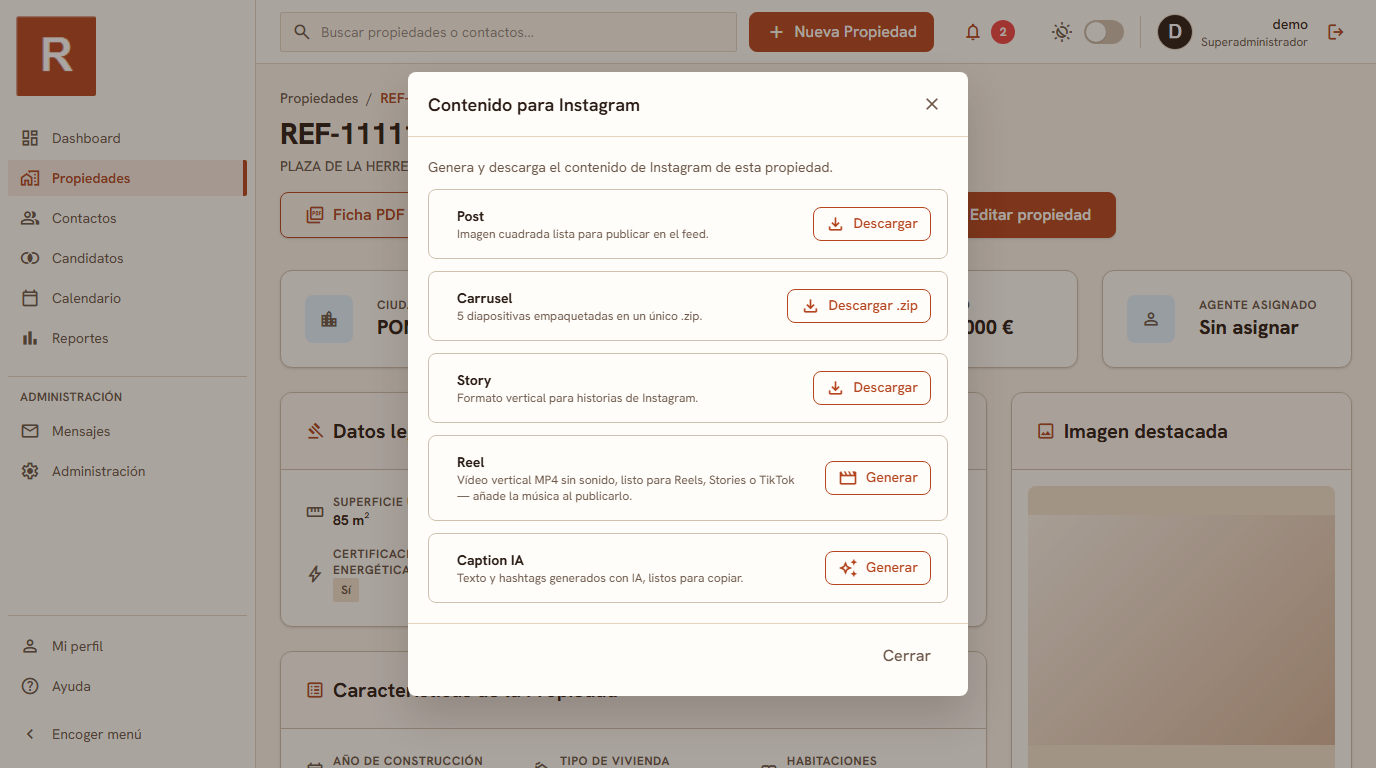
The writing doesn't start from a blank box. The property already has its type, size, number of rooms, floor, price and location loaded — several of those, if it came from a Land Registry lookup, filled in on their own — and it's on top of that data that the AI builds the title and description, instead of asking the agent to retype by hand what the system already knows. The same process generates the keywords and SEO description later used in each portal's title and meta description, and the short caption meant to go with that property's Instagram image.
Using your own AI provider, rather than one bundled into the price, has a practical consequence: the cost of generating or improving a piece of text is billed to your agency directly by Claude, OpenAI or Gemini — or whichever of the other eight you connect — at that provider's own rate, not a fixed RealEstateCRM fee. For an agency registering a handful of listings a month, that cost is close to irrelevant; for one uploading thirty or forty properties, it's worth factoring in when choosing which provider to connect.
Why it pays to read it before publishing it
The text the AI hands back is only as good as the listing data it draws on: if the floor area was typed wrong, or the floor number was never updated after a correction, the description inherits that mistake as smoothly as it writes everything else. That isn't a flaw in the AI, it's a reflection of what was already sitting in the system — which is why the result is worth checking against the listing itself, not just reading on its own.
The other thing worth watching is repetition across portals. Generate the same description once and paste it unchanged into Idealista, Fotocasa and your own website, and you're back to the problem the AI was meant to solve: duplicate content that leaves no search engine sure which of the three deserves priority. RealEstateCRM lets you keep a separate SEO title and description per portal on each property's listing, so what tends to work best is generating a base version with AI and then adjusting details — the order of the selling points, a local keyword — for each portal it goes out on.
A case: fifteen new listings in one busy week
An agency on the Costa del Sol, mostly selling holiday homes, registered fifteen new properties in one week in September, split between two agents. Before connecting its AI provider, each listing carried a description written by hand in ten or fifteen minutes, with the predictable result of similar sentences repeating across flats with similar features. Once the title, description and Instagram caption started being generated by AI straight from the listing, that time dropped to a couple of minutes per property — what's left is checking the text against the real data, and in a couple of cases, correcting a description that mentioned a shared pool in a building that, in fact, doesn't have one, because that field had never been ticked on the listing.
The agency didn't remove the human check, it moved it: instead of writing the text from scratch, it now spends that time confirming the generated copy matches the real property, which tends to be quicker and catches missing listing data sooner.
This AI-assisted writing sits alongside the rest of the CRM's features, and the per-portal SEO title and description management worth using whenever you want to adapt a generated text to wherever it will be published. If your agency still writes every listing from scratch, this is a good place to stop repeating the same line every time.