A custom real estate website connected to your CRM: what you gain over a template
RealEstateCRM España · 9 November 2026
An agency in Lugo drops the price of a flat from 168,000 to 159,000 euros. They change it in the CRM, they change it on Idealista, and three days later they find that their own website still says 168,000 because nobody remembered. A client walks into the office with a screenshot of the site and the price gets argued in front of them. With a custom website connected to the CRM, that second place to update disappears.
A custom real estate website connected to the CRM is a site designed around your agency brand that draws on the portfolio you already manage in the CRM, instead of being a separate page somebody maintains by hand. The difference from a template is not the design, it is that the portfolio gets written once.
What a template solves and what it leaves open
A template makes sense in plenty of cases. It is cheap, it is ready in a few days and it does the job if your agency only needs a basic presence with a phone number and four photos. The trouble starts when the site has to show a real portfolio: every new property, every price drop and every "sold" has to be repeated in another panel, with different fields and a different image format.
That duplicated work barely shows in the first week and shows a lot after six months, when you have eighty listings and the website is always one step behind the CRM. Many agencies end up with a pretty, outdated website, which is worse than a plain one that is correct.
What it means for the website to be connected
Connecting the website to the CRM means the property data travels from a single place. In RealEstateCRM, automatic publishing to your own website works when that site has an open API, and it is already in use today at real agencies. In the custom website service that connection is part of the project: we design it with your brand and your portfolio and leave it linked to your CRM from day one.
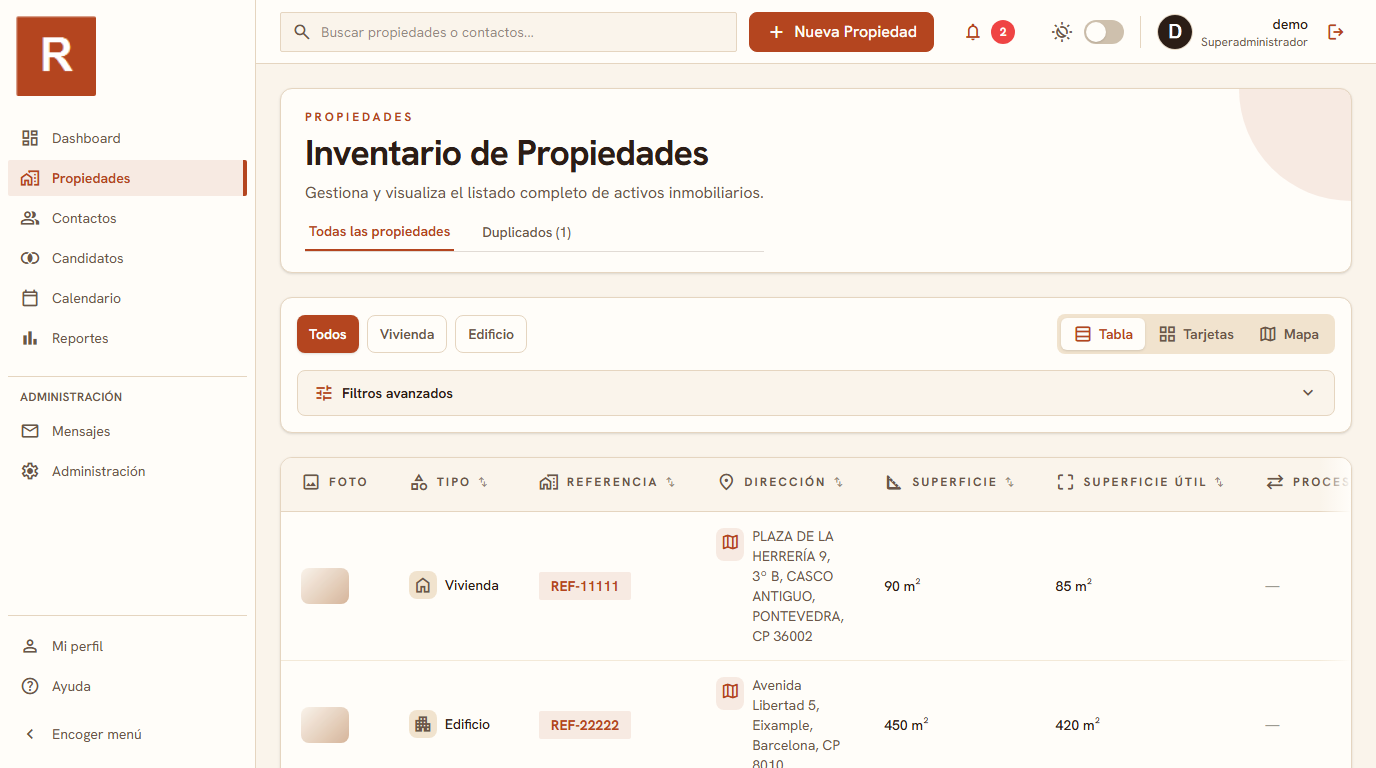
Notice what this does not promise: it does not publish by magic to external portals, because that part is still organised from the CRM without posting on its own. What it does do is stop your own website depending on somebody remembering. If you want to see how the work splits between portals and your site, we cover it in what to automate and what not to when publishing on several portals.
Your brand and your content, at home
There is a less obvious advantage. A portal lends you a shop window, but visitors remember the portal name, not yours. On your own website the listing carries your brand, your text and your phone number, and the content is indexed under your name. For a neighbourhood agency competing to show up in its own area, that matters more than any template with lots of colours.
And if you already generate descriptions with your own AI provider, you can give the website different wording from what you send to portals, so the same listing does not appear identical in three places. We go into that in how your CRM relates to local SEO.
A case: an agency with two offices and a website that ran late
Picture an agency with an office in Ourense and another in Vigo, around sixty properties in all. A junior updates their template website on Fridays. By Monday, half the catalogue has already changed. Once they move to a custom website linked to the CRM, Friday stops being website day: what an agent changes on Tuesday afternoon is on the page that same afternoon.
Visits do not jump overnight, but something subtler happens: they stop getting calls about flats that were already reserved, and the team stops explaining why the website price does not match the advert.
When you do not need it
If your agency has ten properties and the shop window barely changes, a well-made template is enough, and paying for something custom would be overkill. It starts to make sense when the portfolio is bigger than one person can update without mistakes, when you have several offices or when the website is already a real source of enquiries.
If you are at that point, the website service is described in the custom services section, and the rest of what the CRM does with your portfolio is in the features. At RealEstateCRM the website and the CRM are built by the same team, so there is nobody in the middle to ask to "connect" the two.